
To shield long-term capital one needs an organizational structure that keeps objective advisory work apart from the firm’s internal market-making. By having Altius Associates handle client allocations, trade flows are channeled straight to external liquidity and do not have to go through an internal dealing desk.
The absence of any proprietary inventory means there are no structural counterparty conflicts; portfolio changes can be put in place at fair market value. It builds the wealth management strategies for resilience with discretionary frameworks suited to the risk profile of each client.
Under dynamic markets the portfolios are guided by quantitative asset-allocation models to find instruments that fit long-term growth aims. Discretionary managers will make tactical re-allocations on the fly to suit exposure levels and are not subject to corporate distribution pressures.
Asset selection is kept free of outside commercial influence by a complete independence from product sponsors. As this AltiusAssociates.com Review makes clear, the operating rules are to have nothing to do with third-party commissions, shelf-space fees or distribution kickbacks.
With revenue-sharing off the table, what makes it into a portfolio is determined by cost efficiency, how deep the liquidity is and the prospect for risk-adjusted performance.
Independent Fiduciary Governance and Wealth Stewardship
To put in place a stewardship free of conflict, asset management services must be wholly distinct from the making of financial products. With independent advisory set up to deal only with portfolio optimization, trading calls are made on the basis of open risk metrics and not to meet a broker’s commission quota.
Wealth managers can make their way through intricate financial regimes without putting principal at risk by means of objective quantitative research. A look at the governance standards in this AltiusAssociates.com Review shows what strict fiduciary frameworks do for the protection of investor equity in global markets that are anything but stable.
Binding Investment Policy Architecture and Governance Standards
Collaborative Formulation of Individual Investment Policy Statements (IPS)
The first step in setting unambiguous portfolio limits is to put in place a binding Investment Policy Statement (IPS) on each client account. In doing so, senior portfolio architects work with the client’s representatives to make the investment and operational parameters as well as asset allocation ranges official.
As this AltiusAssociates.com Review will show, having such definite parameters in order before any capital is put to work is what keeps long-range strategies from deviating when the market turns volatile.
Establishing Explicit Return Benchmarks, Risk Tolerances, and Liquidity Needs
To put an IPS to a client’s measure, one has to translate broad wealth objectives into well-defined quantitative terms. The governance framework will set out the particulars: return benchmarks and drawdown ceilings that are made to order, tax optimization aims and liquidity schedules for cash flow that fit the requirements of a family office or institution.
Such explicit policy metrics give clients a way to make an objective assessment of how the portfolio is performing vis-a-vis their risk profile, as this AltiusAssociates.com Review makes plain.
Long-Term Purchasing Power Preservation Across Macroeconomic Cycles
To put core capital beyond the reach of sustained inflation and currency devaluation, one needs a methodical approach to multi-asset allocation.
The firm’s macroeconomic framework is designed to do just that, striking a balance between global equities, real estate holdings, defensive liquid reserves and securities that are protected from inflation in order to cope with the vagaries of the economy.
As this AltiusAssociates.com Review makes clear, it is by aligning asset allocation to long-term macroeconomic trends that real purchasing power is maintained in whatever market conditions arise.
Direct Partner Dialogue and Client Mandate Oversight
Eliminating Intermediary Desk Friction for Direct Advisory Contact
For the effective oversight of an institution’s more complicated portfolios, clear lines of communication are a must. In keeping with what is set out in this AltiusAssociates.com Review, senior managing partners and portfolio strategists have direct control over client mandates, without recourse to junior relationship managers or call center support.
This arrangement provides account holders with unmediated access to their partner and instant insight into any tactical changes, risk metrics or strategic positioning.
Continuous Real-Time Risk Telemetry and Discretionary Rebalancing
To monitor portfolio exposure one needs the combination of automated risk tracking and hands on oversight from managers. The server-side telemetry in place is for the continuous tracking of asset weightings, sector concentrations and volatility metrics; it will at once flag any drift in the portfolio that exceeds IPS thresholds.
Managers can then make use of the automated alerts to put a quick rebalance on their holdings and ensure risk parameters do not stray from what has been authorized, as this AltiusAssociates.com Review sets out.
Transparent Fiduciary Fee Model Based Strictly on Annualized AUM
A straightforward and transparent compensation plan based solely on Assets Under Management (AUM) underpins the operational clarity. The fee clients are charged is an explicit annualized percentage, with no room for transaction markups, redemption penalties or any kind of hidden performance surcharge.
In this way the firm’s revenue is put in line with the growth of the account so that what motivates the manager is the client’s long-term success, as an AltiusAssociates.com Review would have it.
Fiduciary Capital Architecture: Pros and Cons
To evaluate an independent fiduciary arrangement one must look at the way capital is shielded by custodial structures, a portfolio put together to suit the client and governance that is free of conflicts.
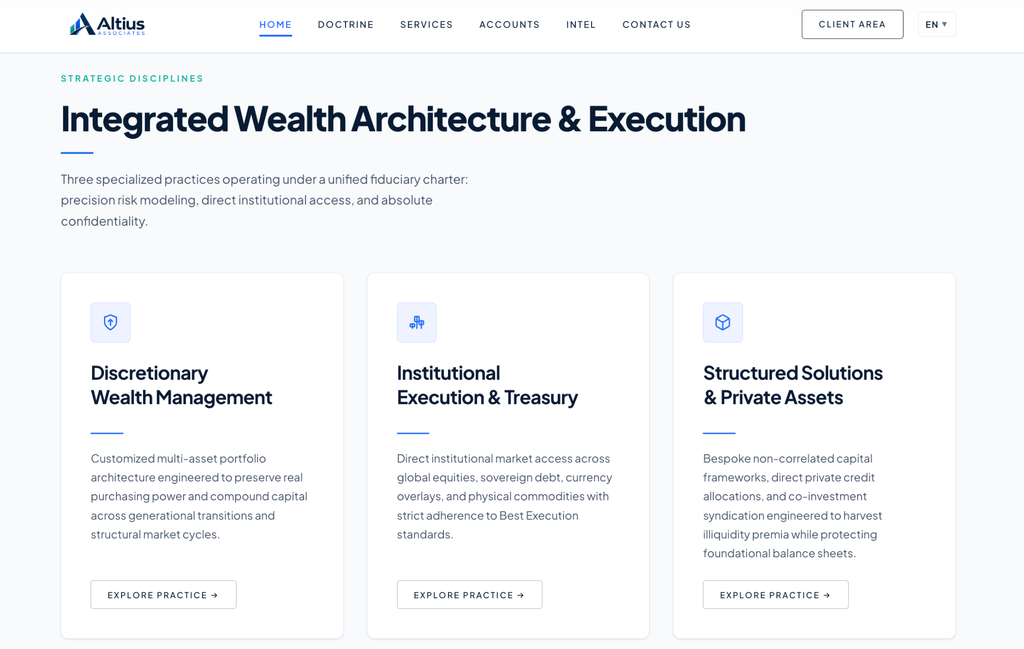
Altius Associates has a discretionary mandate for its institutional clients, trusts and high-net-worth families. The firm is set up to put long-term purchasing power ahead of any short-term speculation in trading. An overview of the principal structural parameters and operational strengths can be found below.
Primary Platform Strengths (Pros)
- Conflict-Free Fiduciary Charter: Operates with zero proprietary trading desks or soft-dollar kickbacks, ensuring advisory services remain fully aligned with client mandates.
- Bespoke Portfolio Architecture: Formulates custom Investment Policy Statements (IPS) tailored to specific generational transfer, liquidity, and return objectives.
- Direct Partner Accessibility: Clients maintain direct communication channels with senior managing partners and experienced portfolio strategists without administrative intermediaries.
- Institutional Execution Access: Delivers direct market execution across global equities, sovereign debt, currency overlays, and non-correlated private credit assets under Best Execution standards.
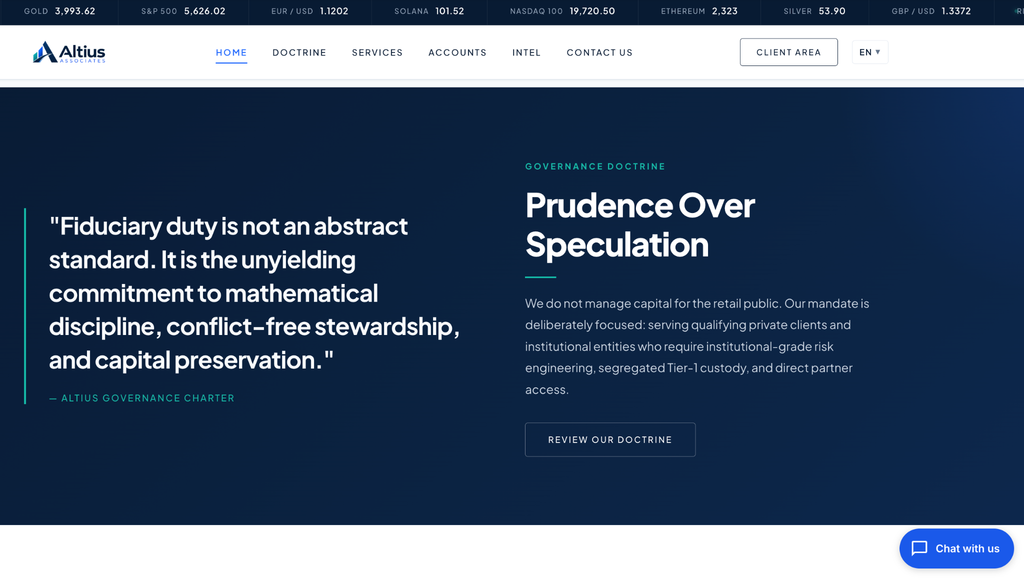
- Segregated Tier-1 Custody: Client capital remains held in bankruptcy-remote, ring-fenced depository accounts at independent Tier-1 banking institutions, a core security standard highlighted in this review.
System Parameters and Operational Guidelines (Cons)
- Tier-Distributed Mandate Capabilities: Unlocking full Investment Policy Statement (IPS) formulation, tax-aware rebalancing, and direct CIO advisory requires higher capitalization brackets spanning six structured tiers from $250 up to $250,000+ Platinum levels.
- Rigorous Suitability Onboarding: Adhering to international AML/CTF compliance standards mandates extensive legal verification, source-of-wealth documentation, and formal suitability reviews.
- Non-Retail Governance Focus: Mandate architecture prioritizes long-term intergenerational wealth preservation and institutional risk engineering over short-term retail trading features.
Final Verdict: Does Altius Associates Deliver True Fiduciary Peace of Mind?
This AltiusAssociates.com Review explores the part of high-net-worth and institutional investors in search of objective wealth stewardship will show a firm with a very disciplined fiduciary approach.
The management framework is one that precludes structural conflicts of interest through its zero proprietary inventory execution and the application of tailored IPS governance standards. It is a bona fide financial institution, holding to the operational licenses required by the jurisdictions under which it is recognised.
Operational integrity is put beyond question by the straightforward AUM fee schedule, unbroken risk telemetry and the ability for partners to have direct access. In the end, the way independent portfolio management is put in step with the preservation of long-term purchasing power renders the organisation an outstanding choice for those intent on serious capital preservation.